LINE BY LINE · NOT A CARBON CLAIM
broadband rf isolator
A broadband rf isolator covers a wide frequency range, and the comparison fails when one quote uses the mid-band insertion loss while another uses the worst point in the window. This workflow is a traceable bill for that comparison. It is not an environmental pledge and it is not a stock list.
- 1 Write the band edges
- 2 Mark worst-case loss
- 3 Split power and load
- 4 Attach the plot to a model
- 5 Normalize money
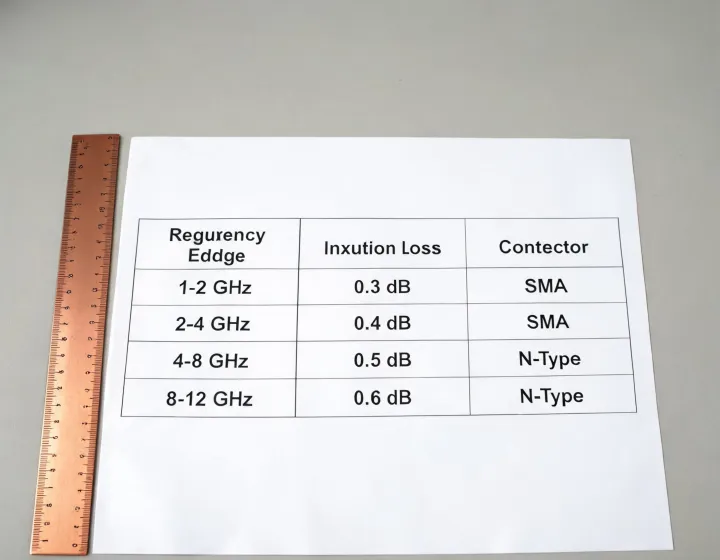
Lifecycle of one broadband line
| Stage in 2026 | Buyer action | What is still unknown |
|---|---|---|
| Band definition | Write start and stop, example 2 GHz to 18 GHz, or a narrower octave such as 2 GHz to 4 GHz | Whether the supplier’s “broadband” label matches those edges |
| Loss and match | Ask for worst in-band insertion loss and the matching VSWR. Example thresholds: 1.2 dB and 1.50:1 | The mid-band typical figure is not the worst point |
| Power split | Forward rating, peak, and termination rating. Example 5 W forward and 1 W load | A wideband body can have a lower load rating than a narrowband PA guard |
| Connector | SMA gender, torque note, and any adapter. 50 ohm unless the chain differs | An adapter’s own insertion loss is missing until it is a line |
| Evidence | Datasheet revision date and S-parameter plot for the model code | A family curve is not the quoted unit |
| Incoming check | Buyer may repeat S21, S12, and S11 on a vector network analyzer after a SOLT calibration at the SMA plane | This desk does not perform that check. Measurement accuracy follows the buyer’s calibration traceability |
| Commercial close | Quantity, destination, Incoterm, currency, per-piece or whole-order basis | Freight and duty until the supplier states them |
Isolation still needs a minimum and a direction. Return loss can be computed from VSWR if both sides agree on the formula. A 1.50:1 VSWR is about 14 dB return loss. That conversion is arithmetic for the buyer, not a plot from LinkScope Sourcing 34. Gain does not belong in this matrix. Transmit power belongs on the amplifier. Polarization and radiation pattern belong on the antenna. Ingress protection belongs on the enclosure unless the isolator is the exposed part. Connector mating cycle belongs here when the SMA port is a test port cycled daily.
Delivery and bandwidth arguments
Wide window
A multi-octave broadband rf isolator can cover a lab that retunes from 2 GHz to 18 GHz without a second part number. The trade is often a higher worst-case insertion loss and a VSWR that is looser at the edges. If the radio uses a 200 MHz slice, paying for unused octaves may add loss you did not need.
Narrow window
A narrowband part can show a lower insertion loss inside its slice, example a buyer ceiling of 0.4 dB from 3.4 GHz to 3.6 GHz, and then fail the same ceiling at 2 GHz. It is the wrong substitute when the bill of materials says broadband. The supplier should state the edges, not a marketing bandwidth word.
What has to arrive with the goods
Ask which documents ship in the box or in the email: datasheet revision, plot, connector drawing, and a packing list that repeats the model code. Lead time is a supplier statement tied to that code. A requested window such as Q3 2026 is the buyer’s date, not a confirmation. Incoterms change who pays freight. A quote that omits the matched load, the adapter, or the export paperwork is not the same delivered scope as a quote that includes them.
Refurbished stock and compatible marks
A new wideband unit may have a clearer drawing revision. A refurbished unit may be the available body for an older connector gender, if the test date and the wear note are present. A vendor-marked part may match an instrument maker’s accessory list. A compatible part may be acceptable when the S-parameters and the power rating match the instrument’s port. Neither choice is certified on this page. Passive parts are not assumed to carry an FCC grant under 47 CFR Part 2 Subpart J. The signal generator or radio might. ISO 9001 evidence still needs a named body and an expiry. The desk has not visited the plant.
Remaining limits: out-of-band specs do not apply, the internal load can be the weak cell, and a room-temperature broadband plot is not a cryogenic datasheet. See cold-stage notes if the temperature is 4 K, port maps if a circulator is still in the running, and inquiry cards for labels. The checklist is the long attribute list.
Compare two replies on one matrix
Send the band edges, the worst-case loss you want quoted, connector, power split, quantity, destination, and timing. After replies return, keep deviations in a column instead of averaging them into one price. Optional budget needs a currency and a basis. Preference for a high-end, mid-range, budget, or undecided factory remains a preference.