PORT MAP BEFORE PRICE
rf isolator vs circulator
The search phrase rf isolator vs circulator is a port-map problem, not a slogan contest. An isolator is usually a circulator with one port terminated, so energy goes one way and the reflection lands in a load. A circulator leaves three ports for the buyer to assign. LinkScope Sourcing 34 asks factories to quote the map you actually wire.
Fields both quotations must share
- Frequency range and impedance. Example buyer window: 2 GHz to 4 GHz at 50 ohm. If one factory quotes 2 GHz to 6 GHz, the overlap is the comparable slice, not the wider headline.
- Insertion loss and isolation, with direction. For an isolator, name input and output. For a circulator, name the port pair, such as port 1 to port 2, and the isolation from port 2 back to port 1. A single “20 dB” cell without a port pair is incomplete.
- Power rating split three ways. Forward average, peak, and the termination rating. On a circulator the termination may be external. On an isolator it is often inside the body and may be 2 W while the line is 10 W.
- VSWR or return loss at each port you use. A 1.25:1 VSWR is a buyer threshold, not a result from this desk. Record the temperature, example 25 C.
- Connector, gender, and adapters. SMA female on the isolator plus an external N-type adapter is a different delivered cost. Ask which IEC connector drawing, if any, the supplier cites. Geometry is not electrical proof.
- Commercial basis. Quantity in pieces, currency, per-piece or whole-order basis, Incoterm, freight, duties, and the 2026 ship window you requested. Exclusions for test plots, matched loads, and brackets sit in their own cells.
Gain, transmit power, and receiver sensitivity stay on the radio row. Polarization and radiation pattern stay on the antenna row. If someone pastes them into the ferrite row, the comparison drifts. Measurement accuracy of any supplied plot should mention calibration traceability, for example a SOLT routine at the SMA reference plane. Connector mating cycle is relevant when the port is a test interface. Ingress protection is relevant when the body is outdoors.
Where the two parts stop being interchangeable
Side A · terminated isolator
Choose this shape when the job is to protect one amplifier from reflected energy. The third port is a load. You then specify the worst reflection you expect, such as an antenna at 3:1 VSWR, and you check that the load rating covers that reflected power. You do not get a second output for a monitor tap unless the supplier adds a coupler, which is another line.
Side B · three-port circulator
Choose this shape when the job is to route energy, for example from a transmitter into an antenna while a receiver listens on the third port. Every port needs a match. An open port is not a harmless spare. Isolation between the pairs you care about has to be written, and an external load is a separate purchase if one path must be dumped.
Vendor-marked part or compatible part
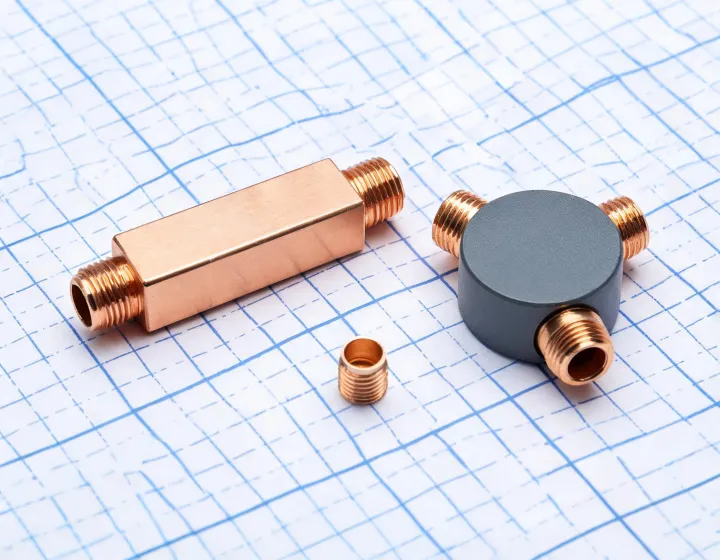
A vendor-marked isolator may align with a radio maker’s approved vendor list and with that maker’s support policy. A compatible body may widen the factory set when the buyer checks frequency range, power rating, connector, and a datasheet dated for the model on the quote. This desk does not score either camp. A photograph of a similar puck is not a host-compatibility test.
New unit or refurbished unit
A new unit can make the connector history easier to read. A refurbished unit can cover a band that left the current catalog, provided the 2026 or earlier test date, the condition statement, and the warranty wording are on the quote. Magnetic bias and heat are still physical limits: a refurbished load does not raise the termination rating.
Three further limits belong in the file. Out-of-band isolation is not the in-band specification. A room-temperature plot is not a cryogenic result; that path is on the cold-stage page. Passive ferrite parts are not automatically listed under an FCC grant. Check 47 CFR Part 2 Subpart J for the transmitter, and ask the supplier what document they will actually send. ISO 9001 evidence, if offered, needs a body name and an expiry. The desk has not audited it.
Worked comparison, not a closed sale: in 2026 a buyer might request 25 pieces, destination Dallas, Texas, SMA female, 50 ohm, 2.0 GHz to 4.0 GHz, insertion loss maximum 0.6 dB, isolation minimum 18 dB, 10 W forward, 2 W internal load. One reply offers a circulator at a lower unit figure and omits the load. The comparable total adds the external load, the adapter, and freight. Until those cells match, the unit figures are not a decision. Read the inquiry cards and the line-by-line workflow before you send the brief.
Send the port map with the quantity
State whether you want a terminated isolator or a three-port circulator, then the frequency range, impedance, power split, connector, quantity, US destination, and timing. Optional budget still needs currency and a per-piece or whole-order basis. Supplier preference is high-end, mid-range, budget, or undecided, and it is not a factory score.