COLD STAGE · SEPARATE LEDGER
cryogenic rf isolator
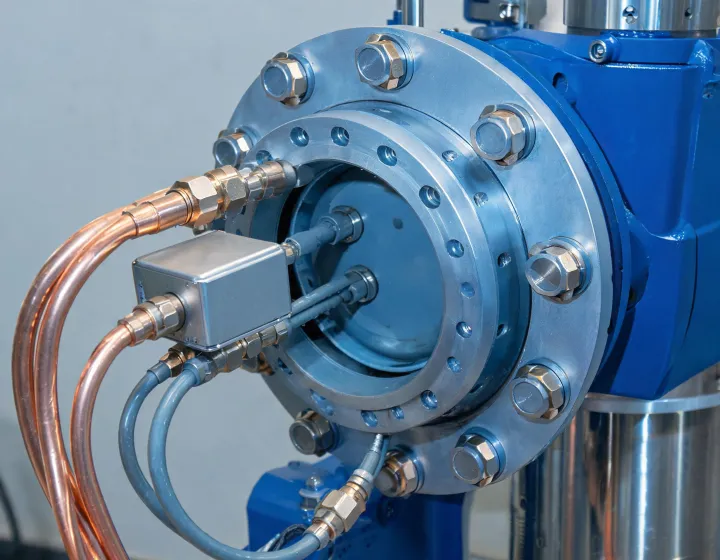
A cryogenic rf isolator lives on a cold plate or in a receiver cryostat, and its insertion loss has to be stated at that temperature. Copying a 25 C SMA catalog cell into a 4 K request produces a quotation that cannot be checked. LinkScope Sourcing 34 treats the cold path as its own bill row.
- Example band 4 GHz to 8 GHz
- Example stage 4 K
- Example forward cap 10 mW
- 50 ohm SMA question
What changes between a bench isolator and a cold one
| Check | Room-temperature high-power path | Cryogenic readout path |
|---|---|---|
| Frequency range | Often a narrow PA band, example 1.8 GHz to 2.2 GHz | Often 4 GHz to 8 GHz for a readout chain; confirm the actual window |
| Power rating | Watts forward, plus a termination that survives reflection, example 20 W into the load | Milliwatts at the device, example buyer cap 10 mW, so heat load on the stage matters more than a heat sink |
| Insertion loss | Specified at 25 C, example buyer ceiling 0.5 dB | Must be specified at the cold temperature. A 25 C number is a different experiment |
| Isolation | Protects the PA, example buyer floor 20 dB | Reduces reverse noise into a quantum-limited amplifier or a cooled LNA. Still needs a port direction |
| Magnetic field | Usually ignored on a bench | The bias magnet can disturb a nearby superconducting device. Ask for shielding notes and a keep-out distance |
| Connector and thermal path | SMA torque and gender | SMA or a cryogenic connector, plus coax thermalization. Stainless or superconducting lines are a separate row |
Impedance remains a 50 ohm question unless the buyer’s chain is different. VSWR and return loss still belong on the row. A 1.25:1 VSWR is an example threshold, not a measurement from this desk. Environmental rating for a cryostat is not an outdoor ingress-protection code. State the cold-stage temperature and the room-temperature flange temperature as two numbers.
How a buyer can ask a supplier to show the plot, without this desk running the test: use a vector network analyzer, calibrate with a SOLT routine at the SMA reference plane, record S21 insertion loss, S12 isolation, and S11 return loss, and write the temperature of the device under test. For a cold part, the temperature might be 4 K or 77 K. Measurement accuracy depends on that calibration’s traceability. A plot taken at 25 C in 2026 does not become a 4 K plot because the filename says cryogenic.
Selection arguments that stay open
Cooled part versus a room-temperature part moved closer
Argument for the cryogenic body: insertion loss at the cold stage can sit in front of a sensitive amplifier, and reverse isolation is measured where the noise matters. Argument for keeping the isolator warm: magnetic shielding and thermal load get simpler, and a high-power catalog part is easier to document, but the loss then sits after the gain of the cold amplifier and does not do the same job. The buyer’s system diagram decides. This page does not.
Vendor-marked package versus a compatible cold part
A vendor-marked package may match a refrigerator maker’s recommended bill and the support path that goes with it. A compatible part may be considered when the buyer has the frequency range, the cold insertion loss, the power rating in milliwatts, and a datasheet for that exact model. Connector mating cycle is a weak signal here because the flange is rarely reworked. New versus refurbished is sharper: a refurbished magnetic package needs a stated test date and a condition note before it is placed near a superconducting circuit.
Limits that survive a careful RFQ
- Isolation outside the frequency range is not the in-band figure.
- Forward power rating is not the heat the cryostat can accept. A 10 mW example cap is a buyer limit, not a universal rating.
- Coax between 300 K and 4 K has its own thermal load. The isolator quote does not include that line unless you add it.
- FCC equipment authorization under 47 CFR Part 2 Subpart J is a transmitter question. A passive cold isolator usually is not the granted item. Ask anyway what document the factory will send.
- ISO 9001, if cited, needs a certification body and an expiry. This desk has not audited the plant. An NRTL sticker is often irrelevant to this passive part.
Project paperwork still includes quantity, the US destination of the cryostat or the lab, the requested arrival window in a named quarter of 2026, and who approves deviations. Polarization and radiation pattern do not describe this component. Gain stays on the amplifier. If the same purchase order includes a data switch, port speed and switching capacity are another family’s rows. The inquiry cards and the form are the handoff. The attribute note lists the wider antenna-and-RF checklist so unused fields can be marked not applicable.
Write the cold temperature into the request
Include the stage temperature, the frequency range, the milliwatt cap, the connector, the shield question, quantity, destination, and timing. A budget still needs currency and a per-piece or whole-order basis.